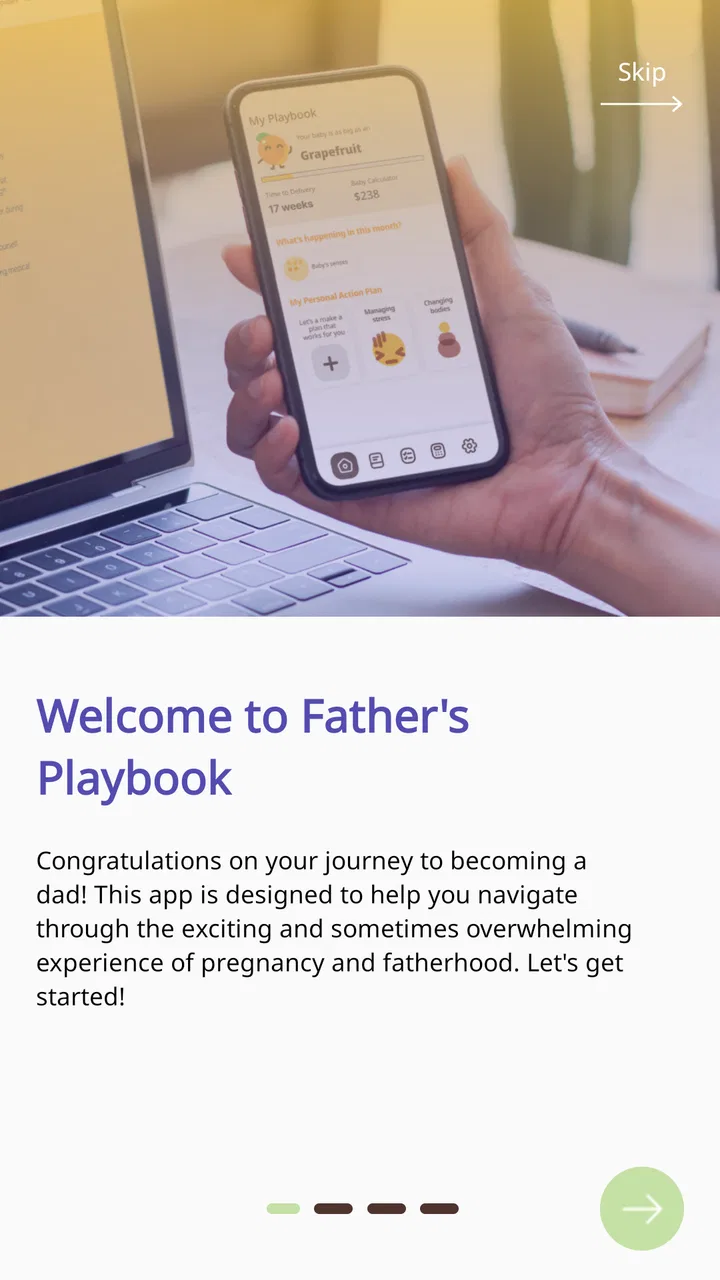
Father's Playbook
- 4.1
- Rating
- 10.00K
- Installs
- Free
- Price

 Analysis by App-foxy
Fatherhood often arrives with a strange mix of excitement, responsibility, and the feeling that everyone else received an instruction manual except you. Father's Playbook takes a focused approach to that problem: it is a free parenting app built specifically for fathers during pregnancy and the early transition into family life. I found its narrow purpose more useful than a broad pregnancy tracker when I wanted guidance framed around a dad's role rather than another stream of medical milestones.
The app is developed by TX Safe Babies and carries an average rating of 4.1 from around a dozen ratings, with over ten thousand installs. That is still a relatively small public track record, so I would treat it as a practical companion rather than an unquestionable authority. Its Everyone age rating makes it approachable for general household use, and the current release is version 5.0.0 for Android 7.0 and later. Most importantly, it costs nothing to try, which removes the usual hesitation around testing a narrowly focused parenting tool.
How I used it as a starting point for fatherhood
My preferred way to use Father's Playbook is not to open it randomly and wait for inspiration. I treat it as a short, repeatable check-in. I look for the guidance that relates to the current stage of pregnancy, choose one idea that can affect the day, and then turn that idea into an action: asking a better question, taking over a practical task, or making time for a conversation.
You May Also Like

 Blood Strike: 2.5 Anniversary
Blood Strike’s Loadouts Turn Every Drop Into a Tactical Gamble
A close look at Blood Strike’s custom loadouts: how fast access to signature weapons reshapes its battle royale rhythm, rewards preparation, and narrows the gap between fights.

 Pandora - Music & Podcasts
Pandora’s Music Is Easy to Start, but Harder to Recover
Pandora’s strength is its low-effort path from a seed to a station. Its weak spot is how much confidence it asks you to place in connection, setup, and quiet recovery.

 8 Ball Pool
 Is Built on Rivalries, Rematches, and Routine
A close look at the rivalries, rematches, shared routines, and unanswered safety questions that turn a quick pool match into a persistent mobile community.

 Samsung Music
’s Quiet Strength Is Playing What You Already Own
Its reach comes less from spectacle than from dependable access to a personal library. That simplicity is both the app’s strongest retention engine and its ceiling.

 AccuWeather: Weather Radar
AccuWeather Review: A Quick, Clear Forecast for Everyday Decisions
For everyday plans, the best forecast is the one you can understand quickly. AccuWeather makes rain timing, radar, and local conditions easy to act on, with a few trade-offs.

 Hill Climb Racing
Why Hill Climb Racing Still Turns Crashes Into One More Run
A tiny car, a bumpy hill and one more upgrade: Hill Climb Racing keeps resurfacing because its simple chaos makes every near-miss feel personal.
More From Our News Desk
View All News


That workflow matters because pregnancy apps can easily become passive reading. A mother-focused tracker may be excellent for appointments, fetal development, symptoms, and medical preparation, but a father can still finish a session unsure what to do next. This app's value is its attempt to translate pregnancy into participation. Instead of merely telling me what is happening, it encourages me to think about how I can show up as a partner.
A realistic example is an evening when both people are tired and communication is short. Rather than opening the app for a long session, I would use it as a prompt before dinner: identify one practical need, ask whether my partner wants help or simply company, and follow through without turning the exchange into an interrogation. The app does not replace that conversation; it gives an otherwise distracted person a reason to start it.
I also found it better suited to small habits than to intensive study. A father who reads every page in one sitting may remember less than someone who returns briefly and connects the advice to real life. The most effective pattern is to use the app before a weekly planning conversation, then discuss appointments, household responsibilities, questions for a clinician, and preparations for the baby together.
What the basic workflow gets right
The strongest part of this approach is the change in perspective. A general pregnancy application usually centers the pregnant person because that is where the medical and physical changes occur. Father's Playbook gives the supporting partner a clearer role. That makes it especially useful for first-time fathers who want to be involved but do not know which involvement is actually helpful.
I would not use it as a replacement for prenatal care, a clinician's instructions, or an emergency resource. Parenting guidance can be reassuring, but personal medical situations require professional advice. The sensible workflow is to use the app for preparation and communication, while keeping health decisions anchored to the care team.
Another practical benefit is that it can help a father prepare before he is asked. Waiting for a partner to delegate every task creates extra mental work for the person already carrying much of the physical burden. I used the app's father-centered framing as a reminder to notice ordinary responsibilities: organizing questions before an appointment, handling errands, protecting rest, and learning enough to participate without making the pregnant partner teach everything from scratch.
There is also a useful emotional angle. Some fathers feel awkward discussing fears because they do not want to make pregnancy about themselves. A focused app can provide a private starting point for reflection. I would still bring serious concerns into an honest conversation, but the initial prompt can make it easier to name what is worrying me and decide whether I need practical information, reassurance, or professional support.
Settings and routines worth checking first
Because Father's Playbook is a specialized app rather than a complete digital family organizer, I would begin by checking how its content is arranged and how easily I can return to the material that matters now. The useful setting is not necessarily a dramatic customization option; it is knowing whether the app fits smoothly into my existing routine. If I have to search through unrelated material each time, I am less likely to keep using it.
I recommend deciding on a fixed moment for opening it. A short session after an appointment can turn fresh information into a shared plan. A weekend check-in can support household preparation. Even a reminder attached to an existing habit, such as making coffee or reviewing the calendar, is more reliable than expecting motivation to appear whenever the app is installed.
For couples, the most effective arrangement is to avoid treating the app as a private scorecard. I would read a relevant section, then ask my partner whether it matches what they need. Advice aimed at fathers can be helpful, but the pregnant person's experience remains the deciding context. A suggestion that sounds sensible in general may not fit a particular pregnancy, work schedule, family situation, or medical recommendation.
It is also worth checking the app after an update rather than assuming the experience never changes. The current version is 5.0.0, which suggests the product has reached a mature numbered release, but a version number alone does not tell me how much content or organization has changed. I would quickly revisit the navigation and any personal routine after updating, especially if I rely on a specific path to find guidance.
Compatibility is straightforward for many older devices because the app supports Android 7.0 and later. That makes it a reasonable option for someone using an older phone, although the day-to-day experience will still depend on the device itself. I would keep the app on the phone I actually carry, not on a tablet that stays at home, because its usefulness depends on being available when a question or planning moment appears.
Faster patterns for busy partners
The fastest useful pattern is the three-step loop: read, translate, act. First, I take in one piece of father-focused guidance. Second, I translate it into a concrete behavior that fits today's circumstances. Third, I do that behavior before opening another section. This prevents the app from becoming a collection of good intentions.
For example, if the current topic makes me think about support, I might prepare a meal, take responsibility for a tiring errand, or ask a specific question about the next appointment. If the topic raises preparation, I might add one item to a shared checklist. If it raises communication, I might choose a calm time to ask what kind of support would feel useful. The important part is that the app leads to an observable action rather than a vague promise to be more involved.
A second pattern is to use it as appointment preparation. Before a prenatal visit, I would note questions in a separate place and use the app to identify areas I may have overlooked as a partner. During the visit, I would listen rather than dominate. Afterwards, I would help convert the answers into practical next steps. This division of labor is valuable because the app can prompt preparation, while the clinician provides the medical explanation.
A third pattern is shared review without forced shared screen time. Not every couple wants to sit together and read parenting content. I can use the app independently, then bring one useful point into conversation. That keeps the tool from becoming homework. It also gives my partner room to disagree, add context, or say that a different kind of help is needed.
For fathers who work irregular hours, a small batch approach is more realistic than daily perfection. I would choose one session at the start of a work cycle and one review before a day off. The goal is continuity, not an impressive streak. Missing a day should not create guilt; the app should reduce mental load, not add another performance target.
There is a subtle trade-off here. A specialized fatherhood app can make participation feel more accessible, but it can also encourage the idea that fatherhood preparation is a separate track from pregnancy. I get the best results when I use Father's Playbook alongside shared planning, not instead of it. The app gives me a lens; the relationship and care team provide the full picture.
Where the app reaches its limits
The narrow focus is both the reason to install it and the main reason some people will outgrow it. If I want detailed symptom logging, appointment management, medication tracking, nutrition records, or a comprehensive newborn schedule, I would look toward a broader pregnancy or family-planning tool. Father's Playbook is more useful for the partner's mindset and participation than for managing every piece of pregnancy information in one place.
I would also skip it if I am looking for a substitute for conversation. No app can infer what my partner needs on a particular day, and no father-focused content should be used to tell a pregnant person how they ought to feel. The right response may be rest, practical help, space, reassurance, or medical attention. The app can encourage awareness, but it cannot make that judgment for me.
The public rating of 4.1 is encouraging but should be read in context because it comes from only a small group of ratings. I would not interpret it as proof that every father will find the content equally useful. The install count, over ten thousand, shows that the app has reached a meaningful audience, but popularity is not the same as clinical authority or a guarantee of long-term engagement.
Another limitation is the possibility of repetition. A focused resource has fewer directions to explore than a full parenting platform. If I already have strong support from a partner, childbirth educator, trusted books, and a well-organized medical team, the app may feel introductory. Its greatest benefit is for the father who wants a clear entry point, not for someone seeking an exhaustive reference library.
I would also be careful about using any general guidance outside its intended context. Pregnancy experiences vary widely, and advice that works as a conversation prompt may not apply to a complicated pregnancy, mental-health concern, or urgent symptom. In those situations, I would contact the appropriate professional rather than spend time trying to solve the issue through an app.
Privacy and phone habits are practical considerations too. I would avoid entering sensitive medical details into any app unless I had reviewed its current privacy information and felt comfortable with the arrangement. For this particular tool, I can gain much of the value by using it as reading and reflection, then keeping personal appointment notes in the system I already trust.
Who will get the most from it
I would recommend Father's Playbook most strongly to a first-time father who feels involved emotionally but uncertain practically. It is also a good fit for a partner who wants prompts for supportive behavior without reading a large general-purpose pregnancy guide. Someone joining a pregnancy later, including a father who has missed earlier preparation, may appreciate the focused route into the role.
It can help couples who keep having the same vague conversation—“Tell me what you need”—without reaching a useful plan. A father can use a topic from the app to ask a more concrete question, then take responsibility for the answer. That is a small change, but it can make support feel less like a favor and more like shared work.
I would be less likely to recommend it to an experienced parent who already has a trusted system and wants advanced medical information. I would also choose a broader app for someone whose main need is tracking appointments, symptoms, or household logistics. In that case, this app could still serve as a supplementary fatherhood perspective, but it should not be the central planning tool.
The free price makes that decision easy. I can test it without committing money, and the Everyone rating means it is not presented as restricted content. Still, free does not automatically mean complete. I would judge it by whether its guidance changes what I do, not by how much material I can browse.
My verdict after building a repeatable habit
Father's Playbook works best when I treat it as a practical prompt for becoming more attentive, prepared, and active during pregnancy. Its strongest contribution is not replacing established pregnancy trackers; it is addressing the gap those tools often leave for fathers. I can open it, find a relevant idea, connect that idea to my household, and take one useful step.
The app is not the right choice for medical decision-making, comprehensive pregnancy records, or a complete family-management system. Those needs call for clinicians and broader tools. Its guidance also has to be adapted to the individual relationship rather than followed mechanically. That limitation is important, but it is not a failure; a fatherhood companion should encourage judgment, not pretend to know every family.
For me, the best test is simple: after using it, am I more likely to notice a need and act before being asked? If the answer is yes, the app has earned a place in my routine. TX Safe Babies has created a focused, approachable resource for dads who want a starting point. Use it in short sessions, turn its prompts into real conversations and actions, and keep professional care at the center. With that approach, the free app is a worthwhile addition for the right father, even if it is not a complete parenting solution.
FAQs for Father's Playbook
01What is Father’s Playbook and who is it designed for?
Father’s Playbook is a parenting-focused app designed to help fathers become more organized, confident, and involved in everyday family life. It may include practical guidance, activity ideas, reminders, and advice related to parenting, relationships, routines, and personal development. The app is generally suitable for new fathers, experienced dads, and anyone looking for structured support while balancing family responsibilities.
02What kind of content and tools can I find in Father’s Playbook?
The app typically brings together parenting tips, family activity suggestions, planning resources, and guidance for handling common situations at home. Depending on the version and platform, users may find articles, checklists, routines, recommendations, or interactive features intended to make parenting more manageable. It is best viewed as a practical companion rather than a replacement for professional medical, psychological, or legal advice.
03Is Father’s Playbook free to download and use?
Father’s Playbook may be available as a free download, but some features, content, or services could require in-app purchases or a subscription. Before installing, check the application store listing for the current pricing model, trial conditions, renewal details, and supported payment options. Reviewing these terms is especially important if the app offers recurring subscriptions, since charges may continue until the subscription is canceled.
04Does Father’s Playbook require an account or collect personal information?
Some features of Father’s Playbook may work without registration, while personalized tools, saved progress, reminders, or community functions could require an account. Before creating a profile, review the app’s privacy policy to understand what information is collected and how it is used. Parents should be particularly careful when entering family details, children’s information, photos, locations, or other sensitive personal data.
05Can Father’s Playbook replace advice from a doctor, therapist, or parenting professional?
No. Father’s Playbook can be useful for general education, motivation, planning, and everyday parenting ideas, but its content should not replace advice from qualified professionals. Questions involving a child’s health, development, safety, mental well-being, or serious family concerns should be discussed with an appropriate doctor, therapist, counselor, or other trusted specialist. Always use professional guidance when a situation is urgent or complex.
Pros
- Practical parenting tips are easy to scan during busy family routines.
- Play-based activities can encourage stronger parent-child interaction.
- Advice is presented in a friendly
- approachable tone for fathers.
- Useful ideas may help dads feel more confident in everyday situations.
- Content can inspire quality time without requiring expensive equipment.
Cons
- Some recommendations may feel too general for complex family situations.
- The father-focused approach may not suit every parenting style or household.
- Activity ideas could become repetitive after frequent use.
- Limited personalization may make advice less relevant to older children.
- Some features or content may require an internet connection.

Father's Playbook
Gallery